
Intraoperative monitoring (IOM)
Intraoperative monitoring (IOM)
Intraoperative monitoring (IOM) is a procedure that involves monitoring neurological function during surgery to help prevent nerve damage. It assesses the integrity of nerves and the spinal cord in real-time while a patient is under anesthesia. IOM helps surgeons ensure that vital neural structures are preserved during delicate procedures, reducing the risk of post-operative neurological complications. This monitoring is particularly crucial for surgeries involving the brain, spine, or peripheral nerves.
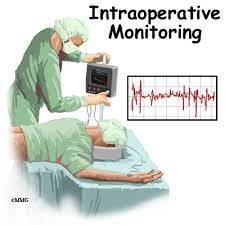
There are two types of IONM:
- Techniques used to identify impending damage to the nervous system.
- Techniques used to map the structures of the nervous system.
To preserve the function of the nervous system (brain, spinal cord, nerves) and to map the structures of the nervous system, we use advanced intraoperative neurophysiological testing, such as:
To preserve the function of the nervous system (brain, spinal cord, nerves) and to map the structures of the nervous system, we use advanced intraoperative neurophysiological testing, such as:
- • Somatosensory evoked potentials (SSEP)
- • Visual evoked potentials (VEP)
- • Brainstem auditory evoked potentials (BAEP)
- • Motor evoked potentials (MEP)
- • Electrocochleography ( ECochG)
- • Electromyography (EMG) and nerve conduction monitoring
- • Electroencephalography (EEG) and electrocorticography (ECoG)
- • Cortical and subcortical motor mapping